Guide · Pressure Washing
Cleaning a Concrete Driveway: Why It Stripes, When to Seal, and the Tool That Gets It Even
A driveway is one of the few surfaces around your home that actually wants real pressure — and yet it’s the one people most often end up disappointed with, streaked with stripes or damaged by the wrong tip. Here’s what builds up on concrete, the one tool that cleans it evenly, when sealing is worth it, how to handle pavers, and how to do it yourself without carving lines into your slab.
What actually builds up on a driveway
Concrete looks solid, but it’s porous — a network of tiny pores that hold onto whatever lands on them. Over a year or two a driveway collects a few different things:
- General dirt and grime — road dust, pollen, and mud worked into the surface by tires and weather.
- Algae and organic growth — the same green-black film that shades your siding settles into concrete’s pores, worst in shade, under trees, and anywhere the slab stays damp. It’s also what makes a driveway slippery when wet.
- Tire marks and traffic scuffing — the darkened tracks where you park and turn, from rubber and road film ground in over time.
All of that is surface dirt, and it comes off with cleaning. What doesn’t are the chemical stains — rust from fertilizer or metal furniture, oil drips from a car, and efflorescence, that white mineral bloom. Those aren’t dirt problems; each one needs its own treatment, and blasting them just spreads them around. If your driveway has one of those, start with our guide to stubborn stains — and know up front that oil is never something an honest company will guarantee.
The surface cleaner vs. the wand
Here’s the single biggest reason DIY and cut-rate driveway jobs come out looking worse than expected: they were cleaned with a wand.
A wand throws a narrow fan of water. How clean any spot gets depends entirely on how fast the person is moving it and how far the tip is from the concrete — and over a big slab, that consistency is impossible to hold by hand. As the operator tires, the spacing drifts, and you’re left with alternating clean and dirty bands. People call it zebra striping or tiger striping, and once it’s there the only fix is to clean the whole thing again, evenly.
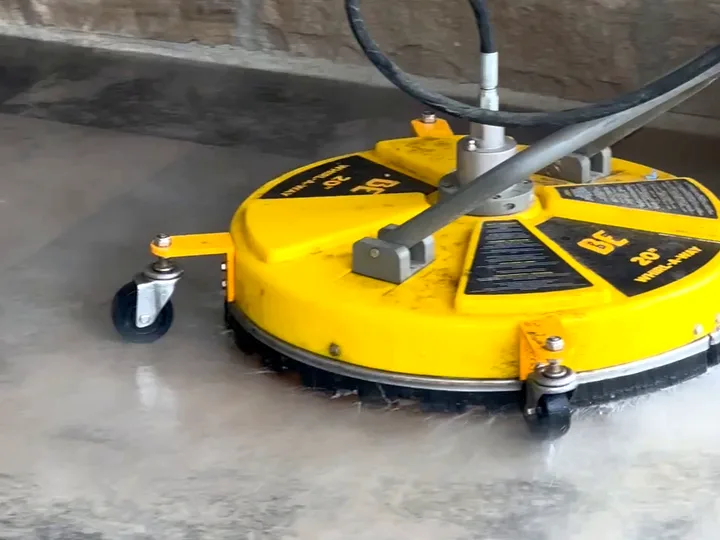
The professional tool is a surface cleaner: a spinning bar of jets housed under a flat hood that rides across the concrete. It cleans the full width at once, at a constant height and speed, so the result is even edge to edge with no lines. It’s also far faster — a surface cleaner can cut driveway cleaning time by well over half compared to a wand — which is part of why the finish is so much more consistent. For the field of the driveway it’s the surface cleaner every time; a wand is only for trimming the edges and corners the hood can’t reach.
Why concrete is the right place for real pressure
It’s worth being clear about this, because so much of exterior cleaning is a warning against pressure. Your siding and roof must never be pressure washed — high pressure forces water behind panels, strips paint, and blasts the protective granules off shingles. Those surfaces get a gentle, detergent-led soft wash instead.
Concrete is the opposite case. It’s a hard mineral surface built to take force, and the algae and grime worked down into its pores genuinely won’t rinse out at low pressure — you need the mechanical energy to lift it. So the same crew that treats your house like glass will, twenty feet away, put real pressure to your driveway. It’s not inconsistency; it’s matching the method to the surface. Concrete, pavers, and stone walkways are exactly where a pressure washer belongs.
Pavers, and the joints that hold them together
Interlocking pavers and flagstone clean up beautifully, but they come with one catch a plain concrete slab doesn’t: the sand in the joints. That sand is what locks the pavers against each other, and if you aim a jet straight down into the gaps you’ll blast it out and leave the pavers loose.
The technique is to keep the spray angled across the surface rather than firing into the joints, and to keep the pressure moderate — a surface cleaner helps here too, since it doesn’t drive straight down. Some joint sand will still come out, and that’s normal. Once the pavers have fully dried, sweep fresh sand back into the joints — ideally polymeric sand, which contains a binder that hardens when you mist it with water, locking the joints tight and resisting washout, weeds, and ants far better than ordinary sand. Don’t re-sand a wet patio; the moisture can stain the binder and stop it setting properly.
Sealing: honest pros and cons
Once a driveway is clean, a lot of people ask whether they should seal it. The honest answer is that it helps but isn’t mandatory — it’s a maintenance choice, not a repair.
What sealing buys you: cleaning opens up the concrete’s pores, and a sealer fills them back in so dirt, oil, and salt sit on top instead of soaking in — which makes future cleaning easier and stains less likely to take hold. It also slows the freeze-thaw damage that does real harm over an Ontario winter, when water seeps into the concrete, freezes, expands, and cracks it. Sealed driveways tend to last meaningfully longer.
The trade-offs: there’s the upfront cost, sealer needs reapplying every three to five years, and some topical sealers get slippery when wet unless an anti-skid additive is mixed in. None of that is a dealbreaker — plenty of driveways are never sealed and do fine — but it’s worth knowing before you decide.
Doing it yourself: tips and cautions
A concrete driveway is one of the more DIY-friendly exterior jobs — it’s hard to hurt yourself and hard to hurt the concrete if you respect a few rules. If you’re renting or own a pressure washer, here’s what separates a clean job from a striped or damaged one:
- Use a surface cleaner attachment if you can. They’re inexpensive to rent or buy and they’re the whole difference between an even finish and zebra stripes. Cleaning a full driveway with a bare wand almost always stripes.
- Never use a turbo or zero-degree tip up close. A zero-degree pencil jet, or a turbo nozzle (which is a zero-degree jet spinning in a circle), concentrates enough force to etch permanent lines and marks into concrete and chew out mortar joints. If you must use one, keep it well back and always moving.
- Keep the tip moving. Dwelling in one spot is what etches. A steady, continuous pace is your friend — let the tool do the work as it travels, don’t pause on a stubborn mark.
- Work in overlapping passes. Overlap each pass by a few inches, in one consistent direction, so there are no faint lines between rows. This is the habit that makes even a wand-cleaned edge look uniform.
- Pre-treat heavy growth. A driveway detergent left to dwell before you clean lifts algae from the pores and kills it at the root, so it stays gone longer instead of greening back in a season.
Where people hand it off is the usual list: a big slab is a genuinely tiring afternoon behind a wand, the growth is heavy, there are stains that need their own treatment, or they simply don’t own a surface cleaner and want it done evenly the first time.
Frequently asked questions
Why is my driveway striped or zebra-striped after pressure washing?
It was cleaned with a wand, which throws a narrow fan whose coverage depends on the person’s speed and distance — impossible to hold perfectly even over a big slab, so you get alternating clean and dirty bands. A surface cleaner cleans the full width at a constant height and speed, so the finish comes out even with no stripes. The only fix for an already-striped driveway is to clean it again, evenly.
Should you seal a concrete driveway after cleaning?
It’s worth it if you want easier future cleaning and better winter protection — sealing keeps dirt and oil on the surface and slows freeze-thaw cracking. It’s not mandatory, though: the trade-offs are cost, reapplying every three to five years, and slipperiness unless an anti-skid additive is used. Whatever you decide, let the concrete dry 24 to 72 hours first, or the sealer will haze and peel.
How often should a driveway be cleaned?
Roughly once a year for most homes. Shaded driveways and ones under trees or near the water build algae faster and may want it annually or twice a year; a sunny, well-drained slab can go longer.
Can you pressure wash pavers?
Yes, carefully — angle the spray across the surface instead of down into the joints so you don’t blast the sand out, and use a surface cleaner where you can. Expect to lose a little joint sand regardless, and re-sand once the pavers are fully dry, ideally with polymeric sand that hardens when wetted.
Does pressure washing damage concrete?
Only if it’s misused. A turbo or zero-degree tip held close will etch lines into the surface and dig out mortar joints. With correct technique — a surface cleaner for the field, the tip kept moving and held back, overlapping passes — concrete cleans up without harm. It’s built to take pressure.
For a sense of the market: HomeStars puts a typical Canadian driveway wash around $200 to $385 depending on size and condition — for Nord’s exact price on your driveway, get an instant quote or see our pricing page. Sources: HomeStars — Pressure Washing Cost Guide, EquipMaxx — Surface Cleaners vs. Wand, Klein Pressure Washing — Sealing After Pressure Washing, Craft Pavers — Pressure Washing Pavers Without Losing Joint Sand.