Guide · Gutter Cleaning
Gutter Cleaning: How Often, the Warning Signs, and Whether Guards Are Worth It
Gutters are the least glamorous part of a house and quietly one of the most important. Their whole job is to move roof water away from the places it does damage — the fascia, the foundation, the basement. When they clog, they stop moving water and start collecting it, and that is where the trouble begins. Here is how often to clean them around here, how to read the warning signs, an honest take on guards, and real safety help if you want to do it yourself.
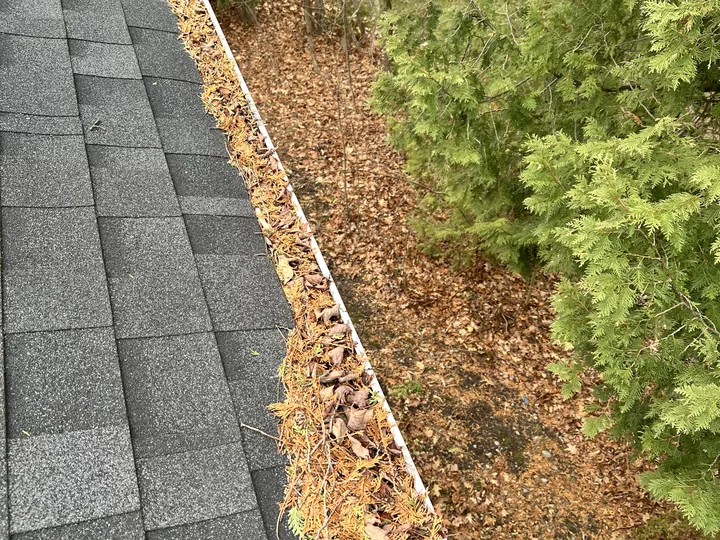
Why gutters matter more than they look
A roof sheds an astonishing amount of water. Every square metre of roof pours whatever falls on it toward the edge, and the gutter is the only thing standing between that flow and the side of your house. Working properly, it collects the water at the eave, carries it to the downspouts, and drops it well clear of the foundation. That is the entire system, and it only works if the trough is clear enough for water to reach the downspout.
When it clogs, water backs up and goes over the front lip in a sheet. From there it does three things, none of them good: it soaks the fascia and soffit until the wood softens and rots, it runs down the wall to pool at the foundation where it can find its way into the basement, and in winter it feeds ice dams. A clean gutter is cheap insurance against every one of those.
How often — and why pines change the answer
For a home in the open, on a normal lot, once a year — the fall clear, after the leaves are down — is the baseline: it gets the leaves out before they turn to sodden mats and freeze solid over winter. Add a spring pass if you have trees overhead: it clears the winter’s rotted leaves, seed pods, and grit so the heavy spring rains can run. Under mature trees, spring and fall is the honest minimum.
Trees change the math, and around Simcoe County the tree that changes it most is white pine. Unlike a maple that dumps its leaves in a two-week window you can plan around, pine drops needles more or less year-round. Those needles are long, thin, and waxy — they slip through gutter screens that would stop a leaf, and they knit together into a dense felt that water cannot pass. A cottage or home tucked under mature pines can genuinely need three or four clears a season to stay ahead of it. If you are pulling out handfuls of needles every time, that is your home telling you spring and fall is not enough.
The warning signs your gutters are clogged
You do not need to climb up to know something is wrong. Watch for:
- Overflow in the rain. Water sheeting over the front edge instead of running to the downspout is the surest sign. Go outside during a good rain and look — a working gutter stays quiet.
- A garden in the trough. Weeds, maple keys, or little seedlings growing up out of the gutter mean there is enough trapped soil and standing water up there to support life.
- Staining on siding and fascia. Dark tiger-stripe streaks below the gutter, or a rotting, discoloured fascia board, come from water that has been running where it should not.
- Sagging or pulling away. A trough full of wet debris is heavy. If a section droops or the spikes are working loose from the fascia, the weight of a clog is usually behind it.
- Pooling at the foundation. Puddles or eroded soil right against the house point to water spilling straight down instead of being carried away by the downspout.
- Pests. Standing water and rotting leaves are an invitation — mosquitoes, wasps, and nesting birds all move into a neglected gutter.
Gutter guards: an honest take
People ask us about guards constantly, usually hoping we will say they never have to think about their gutters again. We will not, because it is not true — but they are not a scam either. Here is the fair version.
What guards do well: a quality guard keeps leaves and large debris out of the trough, which meaningfully reduces how often you need to clean. For a home under leafy hardwoods, a good micro-mesh guard can stretch a twice-a-year job out to roughly once a year, and that is a real benefit.
What guards do not do: make gutters maintenance-free. Fine material still gets through — pollen, shingle grit washing off an aging roof, and yes, those pine needles, which are the exact debris cheaper screen and foam guards struggle with most. Quality varies enormously between products, from flimsy plastic screens that clog on top to surgical-mesh systems that cost real money. And there is a catch worth knowing: a guard can make the eventual cleaning harder, because it has to be removed and refitted to get at what slipped underneath. That is a fair trade for many homes, but go in knowing it is a trade, not a cure.
The fall clear is the one that earns its keep
If you only do one gutter cleaning a year, make it the late-fall clear, after the last leaves are down but before the hard freeze. This is the highest-value timing of the year, and here is why: a gutter packed with wet leaves going into winter does not just sit there. The trapped water freezes, expands, and helps feed ice dams — ridges of ice at the roof edge that back meltwater up under your shingles and into the house. A clogged gutter is not the only cause of ice dams, but it is one you can eliminate in an afternoon. We walk through the whole freeze-thaw mechanism in our guide to ice dams.
For cottage owners, the fall gutter clear is also part of a proper close-up, alongside draining the lines and the rest of the shutdown list — we cover the sequence in opening and closing your cottage.
Scoop, then prove the downspouts — not just scoop
Here is the step most DIY jobs miss, and it is the one that actually matters. Scooping the leaves out of the trough makes the gutter look clean, but the water still has to get down — and the downspouts are where clogs love to hide, packed into the elbows and the vertical run where you cannot see them. A cleared trough feeding a blocked downspout still overflows.
So after you clear the trough, check every downspout. The simplest DIY test is a hose: run it into the top and watch the bottom — a strong, steady stream out the base means it is clear; a trickle or a backup at the top means there is a plug to break loose, usually with the hose, a plumber’s snake, or working it from the bottom up. On our own jobs every downspout is checked and confirmed running clear before we call it done — a drain tool where that settles it, water where it doesn’t. That is the difference between cleaning a gutter and just tidying it.
Doing it yourself: the honest safety talk
We are genuinely happy for people to do their own gutters — it is a fair weekend job on a single-storey home. But the honest hazard in this work is not the mess, it is the ladder. Falls from ladders during home maintenance injure tens of thousands of people a year and kill a few hundred, and gutter cleaning is one of the single most common reasons people are up there. Around forty percent of ladder falls come from the base sliding out, and roughly half of the fatal ones involve people over fifty-five. This is not a scare tactic — it is the reason we would rather you did it right or let us do it.
If you are going up, do it properly:
- Use the right ladder, set correctly. An extension ladder on firm, level ground at a 4-to-1 angle — one foot out from the wall for every four feet of height, which lands you around 75 degrees. Too steep tips back; too shallow slides out.
- Add a stand-off stabilizer. That arm that holds the ladder off the wall lets it rest on the roof edge instead of crushing the gutter, and it widens your base for stability. It is the best small purchase you can make for this job.
- Keep a spotter. A second person footing the ladder makes a genuine difference, and they are there if something goes wrong.
- Never overreach. Keep your belt buckle between the rails and move the ladder instead of stretching for that last bit. Overreaching is how a stable ladder becomes an unstable one.
- Check the downspouts before you call it done — the hose test above.
Where people call us is when the gutters are two or three storeys up, the ground is sloped or soft, the roof is steep, or they would simply rather not spend a Saturday on a ladder. That is a fair call, and it is most of what we do — soft-washed roofs and clean gutters are close cousins, and a clogged gutter often shows up right alongside roof growth we cover in the roof cleaning guide.
What it costs
Gutter cleaning is usually priced by the size of the home and how much access and debris are involved. Across the Ontario market, straightforward single- and two-storey homes tend to land in the $150 to $300 range, with larger, taller, or badly neglected properties running higher — often $350 to $500 or more. Your home is its own number, though, based on its footprint, height, and how the pines have treated it. The honest way to find out is to get an instant quote priced for your address, or see our published rates. Members on NordCare — our exterior window subscription — take 10% off gutter work as an add-on; it is the only discount we run on cleaning services, and there is no obligation to use it.
Frequently asked questions
How often should you clean your gutters?
Once a year — a fall clear after the leaves are down — for a home in the open. Spring and fall if you are under mature trees, and around here that means pines especially: their fine needles slip through screens and mat up fast, so a pine-shaded home can need three or four clears a season.
What are the signs your gutters are clogged?
Water overflowing the front edge in the rain is the surest one. Also watch for weeds growing in the trough, dark staining on the siding or fascia, sections sagging or pulling loose, water pooling at the foundation, and pests moving into the standing debris.
Are gutter guards worth it?
They help — a quality guard cuts down how often you clean and handles leaves well. But they are not maintenance-free: fine debris, pine needles, and shingle grit still get through, quality varies widely, and a guard can make the eventual cleaning a bigger job because it has to come off first. Worth it for many homes, but budget for the occasional clear.
Is it safe to clean gutters yourself?
On a single storey, with the right setup, yes. The real danger is the ladder, not the job — use a proper extension ladder at a 4-to-1 angle on firm ground, add a stand-off stabilizer, keep a spotter, do not overreach, and flush the downspouts. When it is high, steep, or over soft ground, that is when it is worth handing off.
What happens if you never clean your gutters?
Overflowing water rots the fascia and soffit, pools at the foundation and can get into the basement, and in winter feeds ice dams that push meltwater under the shingles. The clog also turns into a pest habitat. It all happens slowly, which is why it gets ignored until the repair costs far more than the cleaning would have.
Sources: Gutter Cleaning Cost in Toronto 2025 · Ladder Safety Statistics (CDC data) · Werner: the 4-to-1 ladder rule