Guide · Christmas Lighting
Planning Your Christmas Lights: DIY or Pro, Colours, and Getting It Right
A good holiday display isn’t about buying more lights — it’s about a bit of planning. Which parts of the house to light, what colour, what kind of bulb, when to do it, and how to do it safely. Here’s how we think through all of that, whether you’re hiring it out or climbing the ladder yourself.
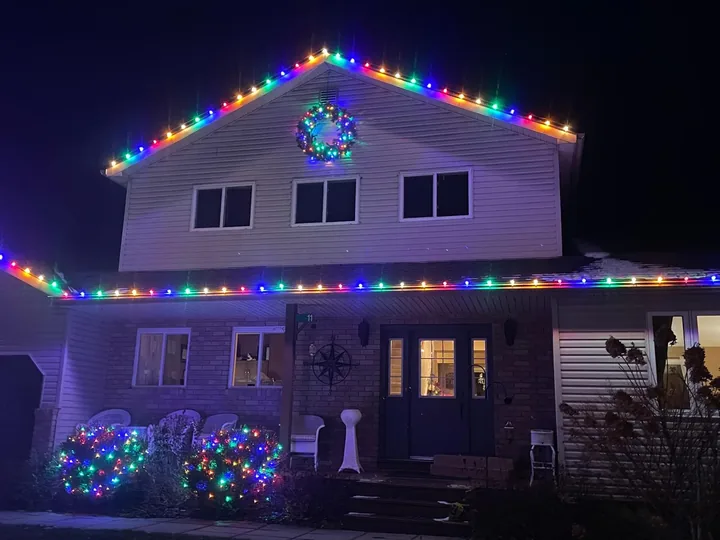
DIY or hire a pro — the honest trade-off
This one comes down to how you want to spend a couple of weekends. If you genuinely enjoy the project, you’re comfortable on a ladder, and you’ve got a mild Saturday to spare, doing your own lights saves real money — the up-front cost is bulbs, clips, and timers, and the labour is free because it’s yours.
What you’re buying when you hire a professional isn’t just the install. A true full-service package includes the design, commercial-grade lights custom-cut to your home, the installation itself, in-season maintenance if a strand quits, takedown once the weather allows, and off-season storage so nothing lives in your garage. Put plainly: the pro premium mostly buys back your weekends and keeps you off a frozen roofline in November. Neither choice is wrong — it’s whether you’d rather spend the time or spend the difference.
Light types: C9, C7, and mini
Most of what confuses people shopping for lights is the bulb codes. There are really only three worth knowing:
- C9 — the big classic roofline bulb. Roughly 2.25 inches tall, the strawberry-shaped bulb you picture on a house. It’s bright enough to read cleanly from the street, which is why it’s the standard for rooflines, peaks, and long runs meant to be seen from a distance.1
- C7 — the same look, smaller. About 1.5 inches tall, a more subtle version of the C9. Nice for closer-up features, porches, and homes where you want the classic bulb shape without it shouting.1
- Mini / fairy lights — the accent. The tiny bulbs you wrap around tree trunks, shrubs, railings, and columns. They don’t line a roof well, but nothing beats them for wrapping and filling.
The bigger quality gap isn’t the size — it’s the grade. Commercial-grade LED strands hold their colour, resist fading, and shrug off winter far better than most store-shelf product, which tends to dim, discolour, and give up a socket or two after a season outdoors. If you’re going to the trouble of hanging lights, hanging good ones is what makes the display look the same in year three as it did on night one.
Colour: warm white, cool white, and knowing when to stop
Colour is where a display either looks intentional or looks busy, and it’s almost entirely a planning decision — free to get right, expensive-looking to get wrong.
The white you choose sets the whole mood. Warm white (a lower colour temperature, roughly 2,700–3,000K) glows soft and golden — classic, cozy, and elegant, the traditional look that flatters brick and stone. Cool or pure white (higher, around 4,000–6,500K) reads crisp, bright, and modern, and it’s the one that makes snow sparkle and glisten for that winter-wonderland effect.2 Neither is "better" — warm suits a traditional home wanting a cozy glow, cool suits a modern one wanting a clean, icy sparkle.
On colour itself, the rule that keeps a house looking sharp is restraint. A single colour reads elegant. A planned two-colour scheme gives you contrast without chaos. Two to three colours is the sweet spot for most homes; past that you’re usually adding visual noise rather than personality.3 A full rainbow can absolutely work — but it’s a deliberate choice, not a default, and it works best when each zone (roofline one scheme, trees another) still feels unified rather than random.
Timing: hang in October, glow in December
The single best piece of holiday-lighting advice is also the least intuitive: put the lights up long before you want them on. The ideal window is mild October weather, before snow and ice make roofline work slow and genuinely dangerous.
The part people don’t realize is that installed doesn’t mean lit. Lights can go up in October and stay completely dark on a timer until you’re ready to flip them on in December — the neighbours never know they’re there. You get the safe, easy install and the December reveal, with none of the January regret about climbing a frozen ladder.
If you’re hiring it out, this matters even more: installer calendars fill fast once the first snow falls, so an October booking is often the difference between getting your preferred date and landing on a waitlist.
Safety: the part worth slowing down for
We’ll be straight with you — roofline lighting is ladder work in cold weather, and it’s where holiday projects go wrong. A few non-negotiables whether you DIY or hire:
- Respect the ladder and the roof. Cold shingles, frost, and ice turn a routine climb into a fall risk. If the roof is steep, high, or slick, that’s exactly the job worth handing off.
- Only use outdoor-rated lights. Outdoor strands are built with heavier insulation and weatherproof sockets; indoor-only lights expose bare connections to moisture and are a genuine hazard outside.4
- Plug into GFCI outlets. Ground-fault outlets cut power the instant they sense a fault, which is exactly what you want in wet, snowy conditions. Outdoor receptacles are required to be GFCI-protected for this reason.4
- Don’t overload the circuit. Every strand has a maximum number that can be connected end-to-end. Exceeding it — or piling everything onto one outlet with a nest of extension cords — trips breakers at best and overheats connections at worst.4
- Clips, never staples or nails. Use clips sized to your shingle or gutter. Staples and nails puncture shingles and cords, invite water in behind them, and are the fast track to a leak and a shorted strand.4
Planning the design (and the free 15-minute consult)
Before a single bulb goes up, the design is really four decisions: what to light (roofline, peaks, garage, a tree or two, columns), what colour (warm vs cool, one scheme or two), what bulb (C9 on the roofline, minis on the trees), and how it reads from the street (symmetry and clean lines beat sheer quantity every time).
That street view is also the secret behind why professional installs look so tidy. The runs are custom-cut to the exact length of each roofline, so there are no dangling tails or bunched spare strand; every bulb is clipped, not stapled; the wiring is tucked and hidden; and the spacing is kept symmetrical. It’s less magic than method.
If you’d like a second set of eyes on any of this — even if you’re leaning DIY — Nord offers a free 15-minute design consultation. It’s a no-pressure walk-through of what would suit your home, the colours that would work with your brick or siding, and what a clean layout looks like. No obligation, just a plan.
Frequently asked questions
Should I install Christmas lights myself or hire a pro?
Both are fair choices. If you enjoy the project and are steady on a ladder, DIY saves real money. Hiring a pro costs more but buys back your weekends, keeps you off an icy roofline, and — with a full-service package — folds in maintenance, takedown, and storage so you never handle a bin. For the money side of the decision, see our cost guide.
What Christmas light colours look best on a house?
Warm white is the classic, cozy, elegant choice; cool or pure white is crisp, modern, and glitters against snow. A single colour or a planned two-colour scheme almost always reads cleaner from the street than a full rainbow. Match the palette to your brick, stone, or trim, and don’t overcomplicate it.
What’s the difference between C9, C7, and mini lights?
C9 are the big classic roofline bulbs (about 2.25 inches), bright enough to see from the street. C7 are the same shape but smaller (about 1.5 inches) for a subtler look. Mini or fairy lights are the tiny bulbs for wrapping trees, shrubs, and railings. Commercial-grade LED outlasts store-shelf product by a wide margin.
When should you put up Christmas lights?
In mild October weather, before the snow. Lights can go up unlit and stay dark on a timer until December, so early install doesn’t mean early glow. Book early — installer calendars fill fast after the first snowfall.
How do professionals get the lights so neat?
Custom-cut runs sized to each roofline (no dangling tails), clips instead of staples, hidden wiring, and symmetrical spacing. Clean lines come from method, not from more lights.
Sources: 1. C7 vs C9 Christmas bulb sizes — Christmas Light Source · 2. Warm white vs cool white colour temperature — ETCH Outdoor Living · 3. Christmas light colour combinations — The Christmas Light Emporium · 4. Christmas light safety, GFCI & clips — The Christmas Light Emporium