Guide · Stain Removal
The Stains a Normal Wash Won’t Fix — and How We Remove Them
A good house wash or driveway clean handles the everyday grime: algae, mildew, dirt, spider webs. But a handful of stains are chemical problems, not dirt problems — and each needs its own treatment. Here’s what oxidation, rust, efflorescence, soot, and oil actually are, how they come off, and our honest odds for the hard cases.
First, why more pressure isn’t the answer
Every stain in this guide has one thing in common: blasting it doesn’t work. Rust and oil smear and spread under a jet of water. Oxidized vinyl can end up permanently streaked by high pressure — the jet cuts clean lines through the chalky layer that no amount of rewashing evens out. The professional approach is the same pattern every time: the right detergent for the stain, time to dwell, gentle agitation, and a thorough rinse. The chemistry does the work.
Oxidation: when siding goes chalky and pale
If your siding looks hazed-over, faded, or slightly orange where it used to be a rich colour — and a dry finger comes away powdery — that’s oxidation: years of UV breaking down the surface of the vinyl itself, not a stain sitting on top. A regular wash won’t touch it, because the chalk is the surface. It’s a separate restoration, and it shows up on painted surfaces and metal roofs too. We cover it fully in its own guide.
Rust: streaks with a source
Rust stains always have a story. The usual suspects around here:
- A rusted chimney cap or flashing — the classic orange streak running down a roof or the wall below it.
- Fertilizer granules — many lawn fertilizers contain iron; spilled on a driveway or walkway and wetted, each granule leaves its own little rust dot.
- Batteries, metal furniture, planters, and tools — anything steel left sitting on concrete through a few rains.
- Well water irrigation — sprinklers running high-iron water paint a rust arc on whatever they hit.
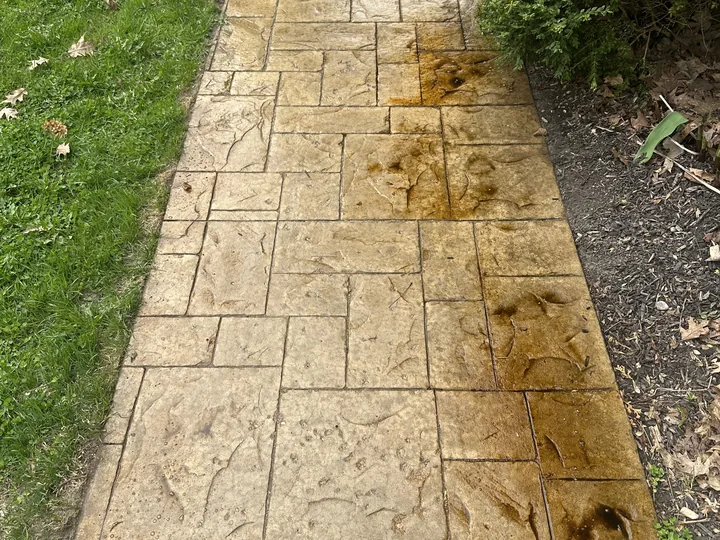
Rust bonds to the surface minerally, so it needs a dedicated rust-dissolving treatment — and here’s the counterintuitive part: the bleach-based detergents that make house washing work so well on algae can actually set rust darker. It’s a different problem needing different chemistry, which is why rust removal is its own line of work rather than part of a standard wash. Where the source is still there (that chimney cap), we’ll point it out — otherwise the streak comes back with the next rain.
Efflorescence: the white bloom on brick and concrete
That white, powdery — sometimes crusty — bloom on brick, block, stone, and concrete is efflorescence: moisture moving through the masonry dissolves natural salts inside it and carries them to the surface, where the water evaporates and leaves the salt behind. It’s common on newer masonry, retaining walls, and foundations, and brushing it just spreads it around.
Cleaning uses a wash formulated to neutralize and dissolve the salts, applied gently — high pressure drives water into masonry, which is exactly the mechanism that causes the problem. One honest caveat: because efflorescence comes from within, it can return if water keeps moving through the material. If it does, the long-term fix is about moisture — drainage, grading, sometimes sealing — and we’ll tell you if that’s what we’re seeing.
Soot and smoke
Soot — around a chimney, above a barbecue, after a fire pit mishap — is fine, oily carbon, and water alone smears it into grey ghosts. It comes off with degreasing detergents, dwell time, and careful agitation, worked from the outside of the stain inward. The greasier the source (barbecue vs. wood smoke), the more the treatment leans on the degreaser.
Oil and grease: the honest section
Oil is the one stain we will never guarantee — and we’d be careful with anyone who does. Concrete is a sponge: a fresh drip sits mostly in the top layer, but an old stain has had months or years to soak deep into the pores, well below where any surface treatment reaches.
What we can tell you from experience:
- Fresh stains respond well. Degreaser, dwell, agitation, hot rinse — a stain from last week often lifts almost completely.
- Old stains fade, not vanish. A years-old patch usually lightens dramatically but leaves a shadow. Repeat treatments help; each pass pulls up less.
- Sooner is everything. If your car just marked its territory, treating it this season instead of next makes more difference than any product choice.
We’ll look at a photo, tell you honestly which category yours is in, and quote accordingly — that’s the "no surprises" rule applied to the least predictable stain there is.
What this costs, and how to book it
Stains vary too much for the flat-rate tables we use for everything else, so specialty stain work is quoted from photos — text a picture of the stain to (705) 242-4888 and you’ll get a firm number. Most stain treatments piggyback nicely on a house wash or driveway clean in the same visit, which keeps the cost down.
Frequently asked questions
Is the oxidation treatment safe for the siding?
Yes — the detergent dissolves the chalk layer, the brushes are soft, and the rinse is low-pressure. The danger to oxidized siding isn’t the restoration, it’s high pressure or harsh scrubbing before restoration.
Will a rust stain come back after removal?
Not by itself — but if the source is still there (a rusting chimney cap, iron-heavy sprinkler water), new staining will build again. We always point out the source so you can decide whether to fix it.
Can I try an oil stain myself first?
On a fresh drip, absolutely: soak up what you can immediately, then dish soap or degreaser, a stiff brush, and a hot rinse. If it’s older or that doesn’t get it, send us the photo before scrubbing harder — some DIY products can discolour the concrete around the stain.