Guide · Window Cleaning
Traditional Window Cleaning: How the Pros Do It (and How You Can Too)
For all the technology in this trade, the tool that still does most of the beautiful work is a rubber blade on a handle. The squeegee has barely changed in a century because it doesn’t need to — done right, it leaves glass cleaner than any spray-and-wipe ever will. Here’s the professional method, scaled down for a Saturday morning at home, plus an honest look at when this method wins and when it doesn’t.
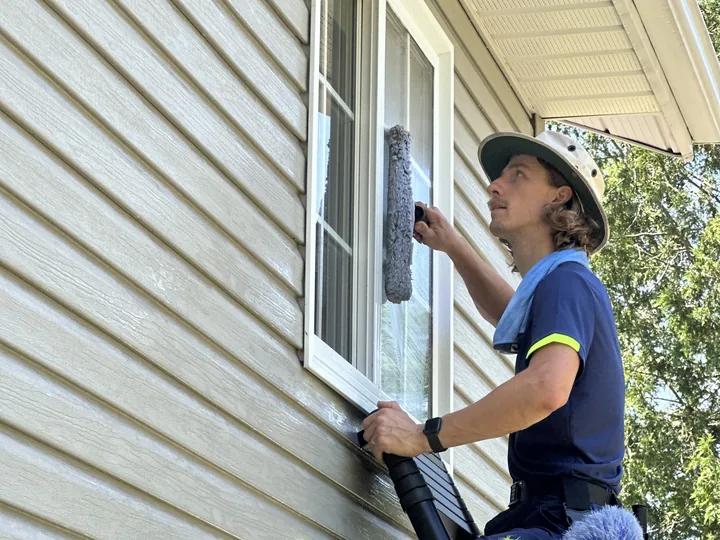
Why the squeegee still rules
Spray cleaners and paper towel don’t remove dirt — they dissolve it and smear it around until it’s thin enough to be invisible from some angles. A squeegee works on a different principle: wet the dirt, then physically remove the water before it can dry. Whatever was on the glass leaves with the water. That’s why professionally squeegeed glass has that particular clarity — there’s nothing on it at all.
It’s also why the squeegee remains the pro’s tool for interior glass, storefronts, and any pane people see up close. (Our other guide covers the water-fed pole method we use for upper-storey exteriors — different tool, different job.)
The kit: about $50, lasts for years
- A squeegee with a quality rubber blade — 10–14″ (25–35 cm) is the friendliest size for house windows. Brands the trade actually uses (Ettore, Unger, Moerman) are $20–30 at a hardware store or online. The rubber is the whole tool: replacement blades are a few dollars, and pros swap them as soon as the edge nicks or rounds over.
- A strip washer (T-bar and sleeve) — the fuzzy scrubber that holds solution and loosens dirt. About $15. A soft sponge works in a pinch.
- A bucket wide enough to dip the washer flat. Any rectangular pail does it.
- Lint-free towels — microfibre cloths or cotton huck (surgical) towels for detailing edges and sills. Not paper towel.
- Dish soap. That’s the secret solution. More below.
The technique, step by step
1. Pick your moment
Clean in shade or on an overcast day. Direct sun on warm glass dries the solution mid-stroke, and dried soap is exactly the streaking you’re trying to avoid. In Simcoe County, that also means working around pollen season — clean right after the June pine-pollen dump, not during it.
2. Scrub the glass
Dip the strip washer, press it against the top of the pane, and scrub the whole surface with a bit of pressure — edges and corners especially, since that’s where grime concentrates. For stuck-on debris (paint flecks, insect residue), a razor scraper on wet glass works, but only push forward, never drag back, and skip it entirely on tempered glass, which can have surface particles that scratch.
3. Cut a dry edge
Run the squeegee (or a towel-wrapped finger) in a narrow strip along the top of the pane. This gives the blade a dry track to start in so it doesn’t skip.
4. Pull the water off
Two ways to do it:
Straight pulls (start here): squeegee straight down from the dry edge, overlapping each pass by an inch or two, and wipe the blade with a towel between pulls. Slightly angle the blade so water runs toward the un-squeegeed side.
The fan (the pro move): one continuous snaking stroke that carries the water across and down the pane without the blade ever leaving the glass. It’s faster and leaves no overlap lines, but it takes practice — get comfortable with straight pulls first, then experiment on a big pane.
5. Detail the edges
Run a dry corner of your lint-free towel around the perimeter of the glass where the squeegee couldn’t reach, then wipe the sill. Don’t wipe the middle of the pane — if the squeegee did its job, touching the glass again only adds smears.
The mistakes that cause streaks
- Too much soap. The most common one. A teaspoon in a bucket, not a glug.
- Worn or dirty rubber. A nicked blade leaves a line of water with every pass. Wipe the blade often; replace it when the edge stops being crisp.
- Cleaning in full sun. The solution dries before you can remove it.
- Paper towel and newspaper. Lint, residue, and (with modern newsprint) not much cleaning power. The squeegee removes the water; towels are only for edges.
- Blaming the wrong side. Before re-cleaning a "streaky" pane, check whether the mark is inside, outside — or between the panes, in which case it’s a failed seal, not dirt, and no amount of cleaning will touch it.
Honestly: when this method isn’t the right one
Traditional cleaning is the best tool for interior glass, ground-floor windows, and anywhere finish quality matters up close. But it has real limits:
- Height. A squeegee above the ground floor means a ladder, and ladder falls are the single biggest hazard in this trade. This is exactly where the water-fed pole is the better tool — upper glass gets cleaned from the ground.
- Frames and screens. A squeegee cleans glass; a water-fed pole’s brush washes the frames, sills, and surrounds as it goes.
- Volume. Thirty-plus panes of cottage glass is a full weekend by hand. It’s a couple of hours with the right equipment.
Neither method is objectively better. They solve different problems, which is why our crews carry both and choose per window, not per ideology.
Frequently asked questions
What’s the best homemade cleaning solution?
Water plus a teaspoon of unscented dish soap. It’s what most pros use. Vinegar mixes and blue sprays tend to streak or leave residue.
Why do my windows streak?
Usually too much soap, worn rubber, direct sun, or paper towel. Fix those four and streaks mostly disappear.
Does the newspaper trick work?
Not really anymore — newsprint ink changed. A squeegee removes the water entirely instead of pushing it around; use lint-free towels for edges.
How often should windows be cleaned?
Twice a year keeps most Simcoe County homes looking sharp — spring (post-pollen) and fall. Homes near gravel roads, farms, or the water often benefit from a third visit.